The history of Bakossi Bible translation
by Hipolite Ngalame Kome (PhD)
The dream of having the bible in one’s mother tongue is certainly one shared by most early Bakossi people (Bekɔ́ɔ̄sē). This was true especially for the christians who had no option than to read the word of God in languages which were not their own. Those who could read, read the bible either in the Douala language or in the English (for the anglophones) or in the French (for the francophones). Later, the Catholics introduced the Pidgin Bible given that Pidgin became “Lingua franca”. The desire to hear the Word in Akɔ́ɔ̄sē led to the fact that, as far back as the early 1900, patches of scripture and prayers were translated into Akɔ́ɔ̄sē and used in almost all churches in Bakossiland (Ekɔ́ɔ̄sē). One of the icons of these early translations was the now celebrated “St. Pius Epiebong” of Baseng, a catholic catechist who lived in Mesaka (Western Bakossi).
These early translations were the vehicle of the gospel and served as the key to the spread of Christianity in most of Ekɔ́ɔ̄sē. Some of the Akɔ́ɔ̄sē prayers are still very useful in most village congregations till date. Given that a vast majority of the people could only understand Akɔ́ɔ̄sē, preaching was mostly in Akɔ́ɔ̄sē. Where it was not, some churches had to use interpreters. A good example of such practice is the Apostolic Faith church.
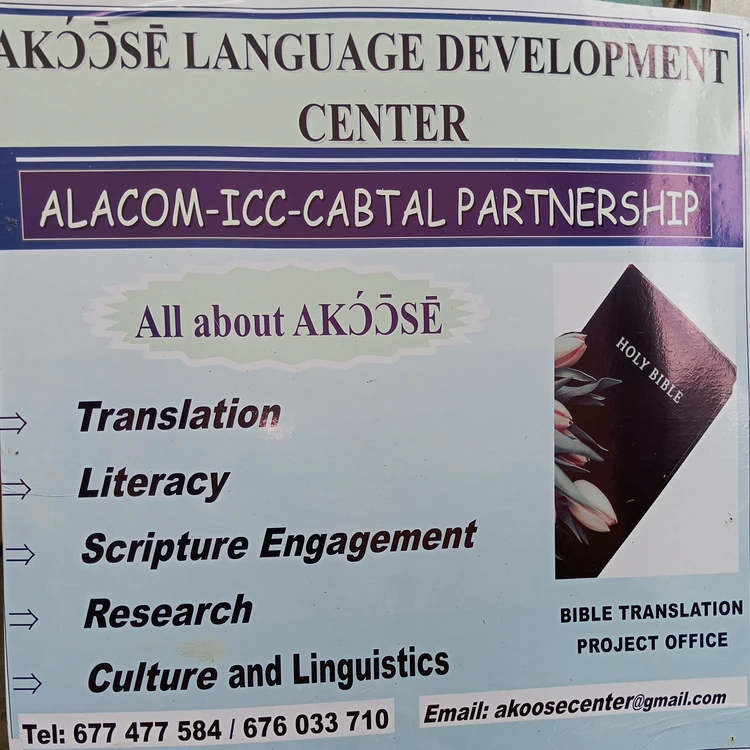
However, what is now formerly known as the Bakossi Bible Translation Project was the brain child of two students of the Presbyterian Theological Seminary in Kumba. These were Pastor Ndando Nelson of Nyasoso (of blessed memory) and Pastor Ekinde of Ngomboku (now Rev Dr. Ekinde- in USA). Though they had this vision while they were still in school, the work actually began several years later (1997) while the then Rev. Ndando was in Mweba-Nninong working as parish pastor of PCC Mweba. Working with the then newly created Cameroon Association for Bible Translation and Literacy (CABTAL) and under the technical supervision of the Summer institute of Linguistics (SIL), their goal was to translate the New Testament. Sometime after that (1998), Rev. Ndando was sent on secondment to CABTAL and transferred to Tombel as the first Project Coordinator. He headed a 4-man translation team including; Pa Ngole Hans Kede, Pa Z.N. Masango and Pa Abraham Kogge (all volunteers of blessed memory). Together they translated the book of Ruth, the gospel of Luke and a few other portions of scripture. The project at this point needed fresh blood for two main reasons. The first was that Rev. Ndando had administrative huddles with CABTAL. The second reason was the fact that the volunteers were of advanced ages. A new team was thus required for the project to meet up with deadlines.
Consequently, by the year 2000, a younger and more dynamic 6-man team headed by Rev. Ngole David as coordinator continued the job. Other members included the then Mr. Hipolite Ngalame, Mr. Nkwelle Ngome Joseph as 2 full time volunteers. Pa Ngolle Ajang Abraham, Mr. Ngole Enongene Daniel and Ps Epie Vincent were also volunteers but on part time. This team was expected to complete the New Testament by 2013. However, thanks to their strong commitment, hardwork and dynamism, by 2011, the New Testament was completed and dedicated. The colourful ceremony that brought together all facets of Ekɔ́ɔ̄sē, CABTAL and donors from Cameroon and abroad was organized in Tombel. The Inter-Church Committee (ICC) led by Pastor Calistus Owowo coordinated the dedication. Glory to God!
At the end of that project, translation activities still went on but on a very low key. Key achievements within that period were; the recording of the audio New Testament (2012) sponsored by Theo Vision and the Translation of the Jesus film (2014) sponsored by the Jesus film project. The anglophone crises were a dark era of silent prayers (2017 -2021). That not withstanding, minimal literacy activities were still striving. Activities included reading in the churches, teaching in the schools and some holiday classes. Some teachers training was also done under the supervision of Mr. Esong Rhodes with some support from BACDA. Yet, the prayers were that the Old Testament (OT) translation too should begin to make the complete bible available to the church in Ekɔ́ɔ̄sē.
Fortunately, these prayers were answered by October 2024. The Bakossi OT Translation Project (BOTP) started! At the initiative of CABTAL, it began with the revamping of the ICC and the selection and training of translators. The new 6-member team is headed by the project coordinator Dr. Kome Hipolite and includes Mr. Ngole Enongene Daniel, Mr. Mwabe Divine Akang, Mme Kwedu Rita Ahone, Pst Metuge Thomas and Pst Esolle Beckly. They have already redrafted the book of Ruth and translated the book of Esther. It is hoped that this project could take between 10 to 20 years depending on the resources available and work methods. Yet we hope it will be fast especially given that some old hands in translation are still involved in the translation work a various levels.
To begin with, Rev. Ngole went to further training and is now a translation consultant at CABTAL assisting other language groups in Cameroon. He will be serving as translation consultant for the Project. Mr Nkwelle (Now Pastor Nkwelle) is now also a Translation Consultant with CABTAL. He is in charge of Training the translators of 6 language groups including Akɔ́ɔ̄sē. Hipolite (Now Dr. Kome Hipolite) well known deputy mayor, writer, lecturer, Literacy Supervisor, dialogue director for the audio NT and Jesus film project, is now the Project Coordinator. Mr. Ngole Enongene Daniel, former translator and Bursar of PCSS Tombel is also on the team which also includes 2 former literacy supervisors (Ps Ngalame Thomas and Mr. Muabe Divine) and two pastors (Pastor Esole). So the team has very adequate capacity to deliver if properly motivated. Though CABTAL and some external donors are doing their best to support some aspects of the project, the greater responsibility remains that of the Bakossi community at home and abroad. The church in Ekɔ́ɔ̄sē and all well-wishers are therefore directly or indirectly concerned. Everyone should therefore pray for the project and support it in any way they can. Little drops make the mighty ocean, so nothing is small. We therefore count on your prayers and support. May God Bless you.
